
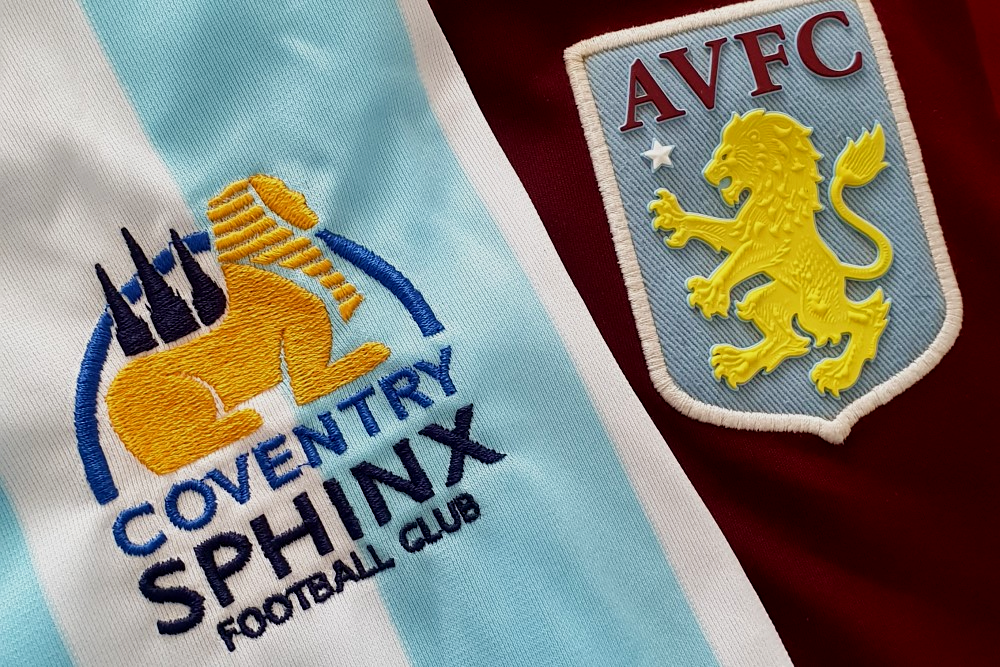
One of the great unavoidable truths of non-league football is that most of us came here from somewhere else. The majority of supporters, no matter how committed and battle-hardened, have shifted or shared their allegiances to some degree.
Some can claim to have inherited their love of non-league from their parents but for the rest of us it is an experience we come to later, first-hand. We go to a game. And then more. And then all of them. And one day it dawns on us that we’ve changed.
My club is Coventry Sphinx. At our matches we have supporters who’ve been there for decades and youngsters whose parents have been involved as players, coaches and volunteers for as long as they can remember. Like every non-league club in England, it is a beautiful and tangled mess of the different connections that brought us all in.
Coventry being Coventry, many of our supporters and players also have another club in common. Coventry City’s presence is significant at Sphinx Drive, not least in the shared loyalties within our community. Fixture clashes are keenly felt at the gate but the relationship between the Sky Blues and our little club up the road is positive and complementary.
When the two meet in friendlies, as they do now and then, it’s a special occasion not only for Sphinx but also for those of us who support – or supported – Coventry City too.
Those friendlies mean absolutely nothing to me.
My other club is Aston Villa. Having been born in Birmingham into a die-hard Villa family, I became enraptured by football at an early age and have no recollection of my first match at Villa Park. More than thirty years of memories have been amassed since then.
The Coca-Cola Cup Semi-Final against Tranmere Rovers in 1994 and the EFL Championship Play-Off Final against Derby County in 2019 are among the best moments of my life, never mind in football.
I’ve seen Villa play in Europe and had season tickets and racked up a good few away games along the way too. That’s not a connection that goes away. But as I got older, as my priorities in life changed, as elite football itself became contorted and mangled into the morally vacant husk it is today, I changed.
Going to Sphinx when Villa weren’t at home became going to Villa when Sphinx weren’t at home became going to every Sphinx match, home or away. I barely even noticed the transition. There was no grand decision, no line in the sand. I just started going to one more than the other and ended up the other way round.
With Villa not entering the Birmingham Senior Cup – the Birmingham County Football Association Senior Challenge Cup, to you – I’ve never even had to think about prioritising them. Why would I? Sphinx and Villa operate in different worlds. Increasingly, they play in different sports altogether.
Now, the Villa’s participation is mandatory. The First Round draw couldn’t have been any better if I’d microwaved the balls myself.
Coventry Sphinx v Aston Villa. An Aston Villa team – young players, certainly, but an Aston Villa team nonetheless – coming to Sphinx Drive for a competitive fixture. Someone who knows me well referred to it as an “emotional derby” but I see it differently. This is my wholly separate football worlds coming together on my doorstep.
It’s exciting for lots of silly reasons, not least the unexpected honour of producing a matchday programme for an Aston Villa fixture, but there’s no question of divided loyalties. I have never wanted Villa to lose a match before and I never will again. I don’t feel conflicted in the least about wanting them to lose this one.
Instead, the draw has been a good opportunity to reflect on broader matters of football supportership and its myriad cultural tributaries.
It is the love of our clubs that unifies and divides us. In a sense, football culture really is that simple. We are tribal and defensive and proud, never willing to concede ground. Football is a social phenomenon underpinned by identity.
Without these fiercely guarded connections between clubs and their supporters, football would be reduced to a silly ball game with labyrinthine rules and pomposity beyond its dues. Strip away the curious rituals that define the act of being a supporter and what’s left is nothing but a pastime entirely undeserving of the importance we bestow upon it.
All of that – every last shred of it – is rooted in club identity. Thus the adoption of and eventual defection to a non-league team rarely destroys the ties we have with the bigger clubs we loved before.
The most fundamental of those ties is the product of love in a much more real sense than anything sport has to offer. Football is family; it really is in our blood.
I grew up supporting Villa because my dad did the same. As a younger man, that was just how it was. Now, as I approach middle age myself, the true meaning of that common ground between father and son, in my case, has revealed itself.
Villa doesn’t matter to me because of Ollie Watkins and Tyrone Mings, or memories of Olof Mellberg and Paul McGrath, or tales of Gordon Cowans and Brian Little, but because the club is the unimpeachable common ground I share with my dad. That’s why I have my own football habits and traditions now, but when Villa Park is the destination, the old ones die hard.
The other celebrated relationship at the core of football culture is the one between clubs and their communities.
In a recent article, Dean Van Nguyen explored the “extremely online” football fans who seem to get no pleasure out of the game. ‘Football Twitter’ is full of these weird little parasites, distant and full of outrageous expectations, and it is the detachment from their clubs and the communities around them that explains their odd behaviour.
For Van Nguyen, the club in question is Liverpool. Their extremely online fans have drawn social media battle lines with the more circumspect local supporters and applied to them the derogatory label of “Top Reds”. There’s even a trend among these bizarre deviants to mock the Scouse accent. I think that says it all.
To me, football clubs and their communities are cosmically and eternally linked. My football experience isn’t just about Coventry Sphinx and Aston Villa and Sphinx Drive and Villa Park. It’s Aston, Birmingham, Coventry. It’s people and places.
No matter my distaste for big oil money in the Premier League or for rich superclubs pushing to dismantle the sport through a European Super League, Villa will always be a part of my life because it’s who I am. I spend my Saturdays elsewhere and have other football priorities, but my club is my club in a way Football Twitter will never comprehend. If you never go, you’ll never know.
I have a shifting notion of home. I considered Birmingham mine but lived somewhere else from an early age, and as a consequence I have moved around a lot and I’ve usually known I would keep doing so. Villa Park was a constant even through the decades when it took three hours of driving to get there.
Now, as an adult with a family and a house and responsibilities, I feel very much at home both in the town where I live and in Coventry, the city where my football club plays. The people I see and talk to every Saturday make this home, just as Villa has been in the past. These are now my roots.
When people ask me about this fixture and my divided loyalties, my response is easy: I have none. I am a Sphinx supporter and I want Sphinx to win. But that doesn’t mean I’ve abandoned the Villa, and that’s why this game will be special to me. I hope it’s a memorable one.
***
Chris Nee
@SphinxFtbl