
Dynastic triumph breeds contempt, and the dynastic triumph of picture-perfect pantomime villains breeds something nastier still. In the first half of the 1990s Alex Ferguson played the role beautifully, ably assisted by a supporting cast of horrible, brilliant bastards.
Eric Cantona was their ringleader. The magic in his feet wasn't innate. It was traded, switched for the soul of a man now doomed to foil his opponents by nefarious means alone for all eternity.
His game was beauty laced with poison. He saw opportunities and conjured up ways to exploit them, tapping into his extraordinary toolbox of backheels or employing his intuitive ability to creatively trick match officials. Cantona was football distilled into one man, fire and poetry wrapped up in a single being.
He saw angles that weren't there and had the touch to use them. He juggled the ball past opponents faster than other players could dribble, working with three dimensions where others were restricted to two.
Cantona was too rich for Sheffield Wednesday's blood when he came to England to train with Trevor Francis' side after his career in France had taken him to Auxerre, Marseille and Nimes, not to mention an impressive list of loans, and instead joined Leeds United.
He made a telling contribution to Howard Wilkinson's First Division triumph and began the Premier League era in the all-white strip of the champions of England, who made a modest profit on him when he was sold to Manchester United in November 1992.
There, he strutted to immortality.
What's the big deal?
Few football players have successfully propagated their own iconography.
Every generation has a handful who try. Some attempt to trademark this or that. Some cultivate a character, be it workaholic trainer or balletic natural or vainglorious demigod. Most, though, want only to win or to entertain, their legacies cast in silver and determined by their individual contributions to the teams they represent.
Icons tend to be anointed after the fact, elevated by history and mythology as our recollections of their peaks become grainy. The passage of time is out of the control of even the world’s best footballers. They just do what they do. Excluding the five or ten greatest ever players, icon status comes much later if it comes at all.
In the 1990s one player authored his own legend in real time. Cantona’s words have proved their stickability over the years but they were rarely as incisive, as exotic or as eccentric as advertised. His best self-portraiture was always created on the football pitch.
It was as if Cantona thought in silhouette. Even his infamous altercation at Selhurst Park was possessed of perfect form, easy to picture a quarter of a century later. The backheeled passes, every one played with the straight back of a truly confident man, were unmistakably Cantona.
In that regard only Diego Maradona is his equal. Remove everything from the Hand of God goal but Maradona’s outline and almost every football supporter in the world would be able to identify the goalscorer, the year, the circumstances and the flapping, objectionable goalkeeper who couldn’t out-jump him.
But Maradona’s singular silhouette was that of the world’s best footballer cheating. Cantona’s was different. Cantona was no angel but it was the defining image of everything heavenly about him. Unique. Cocksure. Brilliant.
He set his own stage by scoring a truly special goal at Old Trafford in December 1996. Then he performed.
Did this goal actually mean anything?
Cantona’s tumultuous start to life at United yielded a succession of red cards and the kind of enfant terrible image that simultaneously summed up and underestimated his combustibility.
In January 1995 he lost his rag yet again, this time the result of what Alex Ferguson felt was undue roughing from Crystal Palace at Selhurst Park. The Frenchman kicked Palace’s Richard Shaw and was sent off by referee Alan Wilkie.
What followed was one of the most infamous moments in Premier League history; Cantona’s micro-brawl with Palace supporter Matthew Simmons earned him a suspension from his club, a ban from football that lasted rather longer than that, £30,000 in fines, and a court date that nearly put him behind bars for two weeks.
Cantona returned to the United line-up in October 1995 and ended the 1995/96 season as the top goalscorer in Ferguson’s famous double-winning team, scoring the only goal in the FA Cup final against Liverpool to end the campaign on a particularly high note.
The following season started in similar fashion for the Red Devils. 21-year-old David Beckham scored from the halfway line against Wimbledon on opening day to steal the first headlines of the season and get United off to a flyer. It wasn’t to last. Their form was decent but patchy through the autumn and a 5-0 loss to Newcastle United in October was a difficult pill to swallow.
By the end of November the season was starting to turn around for Cantona and United. They embarked upon a run of sixteen matches unbeaten in the Premier League and lost only twice between their defeat to Chelsea on November 2nd and the end of the season.
That kind of form tends to turn to silver. United won the league again, with Cantona as their captain, and their 5-0 victory over Sunderland at Old Trafford on December 21st was more lubricant than catalyst.
Cantona’s goal had little tangible bearing on the result or United’s season. He’d already scored from the penalty spot to make it 2-0 just before half time, and Ole Gunnar Solskjaer’s second immediately after the break put United 3-0 up. Nicky Butt added a fourth twenty minutes before Cantona forcefully took centre stage.
But football is a game of intangibles too. Cantona’s goal gave him, and his team, an air of invincibility. In one sweeping movement Cantona’s aura somehow found a new level of imperiousness. United became more intimidating than ever. They felt unstoppable.
Get on with it...
United, in their Umbro home shirt whose deep red diamond sleeves and monochrome colour seemed to make them even more fearsome than usual, were 4-0 up and cruising.
Cantona collected the ball just inside Sunderland’s half and slalomed into space to begin the run that would culminate in one of the Premier League’s best loved goals.
He was initially under pressure from two opponents. One was quickly left in his dust. The other, locally raised Richard Ord, tried in vain to catch the Frenchman until the distracting presence of United’s Czech winger Karel Poborsky cut across his efforts. Cantona floated in-field and Ord was gone.
Andy Melville was next to face Cantona, now in full flow, but the Welsh international arrived head-on and Cantona saw him coming. He passed to Brian McClair -- like Poborsky a second-half substitute -- and effortlessly squeezed beyond Melville and Ord as they collided in his wake.
McClair held the ball with Sunderland’s Gareth Hall in close attendance and fed it back into Cantona’s path as he reached the end of the penalty area. There, without a touch, Cantona slowed his pace, sized up Sunderland goalkeeper Lionel Perez, and lifted the most gorgeous chip over his former team-mate and into the top corner.
It kissed off the post on the way in; Cantona, by then stationary, had already started to turn away from goal and soak up the glory of his own genius.
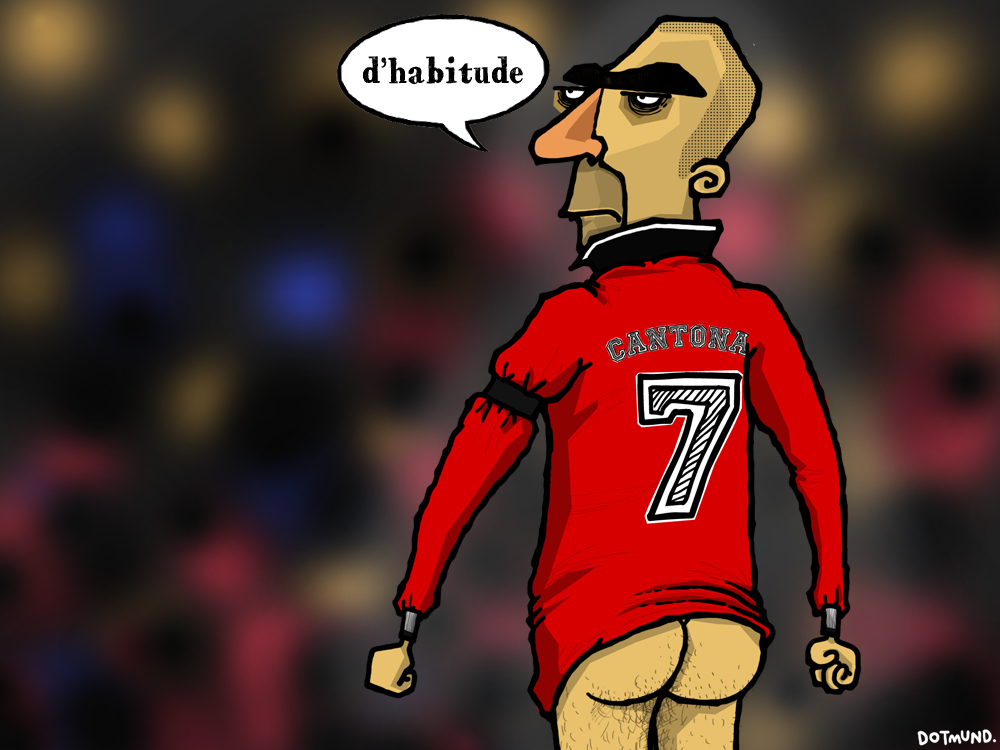
The moment between the ball nudging the post and Cantona receiving McClair's embrace represents one of the most famous goal celebrations of all. Collar up in that blasé way only Cantona could manage, the United skipper simply looked around the stadium, surveying the reaction to what he'd done, before holding his arms out just to make sure his arrogance sunk in.
Quite apart from the finish, this was a goal that demonstrated Cantona’s mastery of a football. From the moment he turned to face the Sunderland goal he completed the whole move in just six touches. They took him away from two opponents, evaded Poborsky’s intervention, ate up thirty yards of pitch, brought McClair into play and embarrassed Perez. It was majestic.
So, this is a goal people talk about?
Cantona won a stack of titles and scored a great many spectacular goals in England. His all-round play was striking in itself, and that unmistakable silhouette must still be scarred into the memories of his prey.
None of those moments was as memorable for the neutral as his wonderful chip against Sunderland.
“No Cantona moment, with a football at least, is more instructive than his goal against Sunderland in December 1996,” suggested Iain Macintosh of ESPN twenty years later. He described the finish as “sensual”, and who could deny that?
“And then he slowly turned. Like a dragon who has just destroyed a nearby village, he turned to the cowering adventurers. ‘Foolish humans. To think that you could ever oppose me,’ he seemed to say.”
Of course, Cantona’s celebration is every bit as historic as the goal itself. In Portrait Of An Icon, Daniel Storey explained why the two cannot be separated.
“The brief moments during which a forward knows the ball is heading into the net are some of the most glorious in sport, and therein lies the splendour of a chip,” he wrote.
“It prolongs those moments to their maximum. Perez never stood a chance, because Cantona never countenanced doubt. The celebration, a slow-motion turn to his audience, was of an artist who had mastered his art. The artist now intended to milk his magnificence.”
Niall Quinn, Sunderland’s former Manchester City striker, missed the lion’s share of his first season at the club through injury but later recalled the reaction on the bench. (Quinn is quoted as saying he was substituted that day. He was not in a matchday squad between the end of September and the start of April, but his presence on the bench is not necessarily in doubt.)
“Eric Cantona picked the ball up and waltzed through about three of our players, chipped the goalkeeper Lionel Perez, and famously turned round to take the adulation from the Old Trafford faithful, he put his collar up if you remember and struck that pose,” he remembered.
“When he scored, our kitman John Cooke, he's a Manchester United fan born and bred. As soon as Cantona scored, he jumps up and sticks his hand up in the air. Everyone looked at him and he just went, 'Offside ref!' Everyone was giggling but Peter Reid was going to kill him.”
Cantona himself has crafted the story behind the celebration because of course he has. In 2020 he told a club podcast that a snub from Perez, with whom he’d played at Nimes before leaving France for Yorkshire, was the origin of this uniquely Cantona moment.
“Before the game, in the tunnel, I came to him to shake his hand and say hello to him because I hadn't seen him since I left. It was the last club I played for in France,” he mused.
“And he didn’t want to shake my hand. So maybe I scored this goal because of that. That’s the biggest humiliation for a goalkeeper, and this kind of celebration too. Because he’s angry and you don’t run anywhere. I just stand there. Look at me.”
Petty revenge. A dish best served with chips.
Shouldn’t Alex Ferguson take some of the credit?
Pantsing Perez at Old Trafford was all Cantona’s work -- in many ways it was Cantona distilled, a potent concoction of sensational and snide -- but its proximity to the end of his ban from football was significant.
Ferguson was firm but fair with Cantona after Selhurst Park, attempting to protect his player by punishing him in the name of Manchester United and displaying admirable loyalty throughout his absence. Then, in October 1996, he gave him his place back.
Indeed, he took a chance signing Cantona in the first place. His behaviour in France had long since established him as short on fuse and long on fury, and the manager’s ability to see through that was crucial to his, Cantona’s and United’s successes in the 1990s. He was, he said, not interested in tittle-tattle.
Storey’s Portrait Of An Icon identifies Gary Pallister, Steve Bruce, Bryan Robson and Lee Sharpe as skeptics. Cantona hadn’t yet crossed the line in England as he had in France but his relationship with Leeds manager Howard Wilkinson did little to dissuade his critics from the possibility.
“Ferguson deserves immense credit for his faith, forging his reputation on successful hunches that would form the backbone of his Old Trafford dynasty,” wrote Storey.
“Having taken advice from Gerard Houllier on Cantona, United’s manager trusted that view and made his move. Rather than the flash foreigner who would damage Ferguson’s career, Cantona became United’s lodestar.”
The writer also references Cantona: The Rebel Who Would Be King, Philippe Auclair’s biography of his countryman. Auclair posits that Ferguson offered as much to Cantona as Cantona offered his manager.
Storey again:
“Throughout his career, Cantona was searching for the father figure who could understand his personality, manage his flaws and nurture his individual brilliance. It is a testament to Ferguson’s man-management skills that Cantona found that paternal influence in him.”
Ferguson and Cantona achieved much together. Either side of Selhurst they twice won consecutive Premier League titles, adding the FA Cup in both 1994 and 1996. Cantona scored three of United’s five goals across the two finals.
The Red Devils reached higher heights two years after Cantona retired, winning the Champions League as part of an impressive and memorable treble in 1998/99. The team that beat FC Bayern in the final in Barcelona featured Beckham, Solskjaer, Peter Schmeichel, Ryan Giggs, Gary Neville and Denis Irwin, United favourites to a man.
Cantona never reached their pinnacle. They never matched Cantona’s magnetism.
What happened next?
From November 30th 1996 Sunderland alternated between victory and defeat for six games on the spin. The matches immediately before and after their thumping at the hands of Solskjaer, Cantona and United were their fifth and sixth wins of the season.
By the end of an unbeaten January Peter Reid’s side looked capable of avoiding relegation. but they won just three of their last sixteen league matches, once against Manchester United, and were relegated in eighteenth place. They finished just one point behind a Coventry City team saved by Middlesbrough’s points deduction.
Four consecutive losses in the spring represented their worst run of the season and they lost at Wimbledon on the final day. Coventry won at White Hart Lane and the Black Cats were down.
A win over Southampton on February 1st took United to the top of the division and their reliably excellent league form ensured that they stayed there. They finished seven points ahead of Newcastle to claim their eleventh league title.
But Cantona’s footballing denouement was already bubbling away in the background. In the Champions League semi-finals United were beaten over two legs by eventual winners Borussia Dortmund. Cantona later revealed that it was this tie that brought about the end of his career. His heart, he said, wasn’t in it anymore.
When he returned to Old Trafford to say goodbye to the supporters Cantona said that, “I quit football because I lost my passion for the game.”
Some players drag out their careers because they love football, others simply to drag them out. Cantona packed it in at 31 at the end of 1996/97, a season in which he’d played and scored plenty and won his fifth English title.
Before and after leaving the game Cantona made his mark not just in sport but in acting and advertising, artistic pursuits he’s continued long into his football retirement. In 2009, Ken Loach cast him in Looking For Eric, in which he played the former Manchester United captain Eric Cantona.
Let’s face it; it was no Good vs Evil.
The fondly remembered 1996 Nike ad featured Cantona, Luis Figo, Paolo Maldini, Edgar Davids, Ronaldo, Patrick Kluivert, Ian Wright and more on the side of good, standing up for the world and its football in the face of evil invaders. It’s a binary battle as old as time.
The truth of Cantona was and is rather more complicated. Au revoir.
***
Words by Chris Nee. Art by Dotmund.
@SphinxFtbl